Learn · 8 min read
To lock in, pick one goal for the rest of the year, write three to five if-then rules for it, and set a "minimum day" you can hit even on your worst day. Then keep one rule above the rest: never miss twice, so a bad day stays a bad day instead of ending your season.
To "lock in" means to get into a state of serious focus. The Great Lock In is a TikTok trend where people use the last four months of the year, September 1 to December 31, to work on themselves now, instead of waiting for January.
The trend spread on TikTok in August 2025, when early videos framed the last months of the year as a focused push (Know Your Meme; Daily Dot, 2025). BuzzFeed reported on September 7, 2026 that earlier years were mostly about fitness, while this year's version also takes in mindfulness and mental wellbeing.
You'll also see "Winter Arc." It's the same idea with different words. "Arc" comes from fiction, where a character changes over the course of a story. A Winter Arc is your own version: the months where you change and come out the other side a little different (Daily Dot, 2024).
Most pages stop there. They explain the trend. This one gives you a plan that still works on the day you mess up.
Most lock-ins fall apart because they were built for your best day, not your average one. By week three, the excitement of starting has worn off, the finish line is still months away, and the first missed day shows up.
That last one has a simple fix. Brandon, who founded The Motivational Hub, has sold on eBay since 2011. During one long push to grow his store's 90-day sales total, he never aimed at the final number. At each milestone he asked, "I wonder if I can get it to the next one?" One near target at a time carried him to the end of December, and to a sales high he hadn't thought possible a few years earlier.
Write your rules as if-then plans: "If [a moment that happens], then I [do this one thing]." The trigger does the remembering, so you don't have to rely on how you feel.
The research behind this is strong. A 2006 meta-analysis by Peter Gollwitzer and Paschal Sheeran pooled 94 independent tests of if-then plans and found a medium-to-large effect on reaching goals (d = .65).
The If-Then Plan in the Goal Getter Pack walks you through this on paper.
A minimum day is the smallest version of your goal that still counts. It's what you do on the day when everything goes wrong, so the chain stays unbroken and you never have to restart.
Keep it to 10 minutes or less:
| Goal | Full day | Minimum day |
|---|---|---|
| Write 500 words | 500 words | 100 words |
| Read more | 30 pages | 1 page |
| Learn a language | 20-minute lesson | 5 flashcards |
| Grow a side business | 2-hour work block | List one item or send one email |
The minimum day pairs with one rule: never miss twice. Missing once is normal. A 2010 study by Phillippa Lally and colleagues followed 96 volunteers building a daily habit for 12 weeks. Missing one chance to do the behavior "did not materially affect the habit formation process."
Brandon's approach to a missed day is plain: don't try to make it up. That day is in the past, so put your focus on the day in front of you. You don't owe yesterday a double session. You owe today a minimum. That's how you stay locked in: not by never slipping, but by never letting one slip become two.
At week 6, stop for 15 minutes and look at what actually happened. Don't add goals. Fix the rules that broke.
Answer these on paper:
A free Weekly Proof Sheet makes this easier, because you'll have six weeks of notes to read instead of a fuzzy memory.
End the season by counting what you kept, not what you missed, and by naming what comes next before the season is over. A finish line you plan for doesn't feel like falling off a cliff.
Brandon's one rule for the rest of the year: stick with a goal until it's done, and have the next goal ready before you reach the current one. That way, the end of a season is a handoff, not a drop.
In week 13:
As Dr. Wylie told BuzzFeed, "A healthy 'lock-in' should still leave room for flexibility, rest, and enjoyment."
Worked example: a 13-week Lock In for "write 500 words a day" (illustrative)
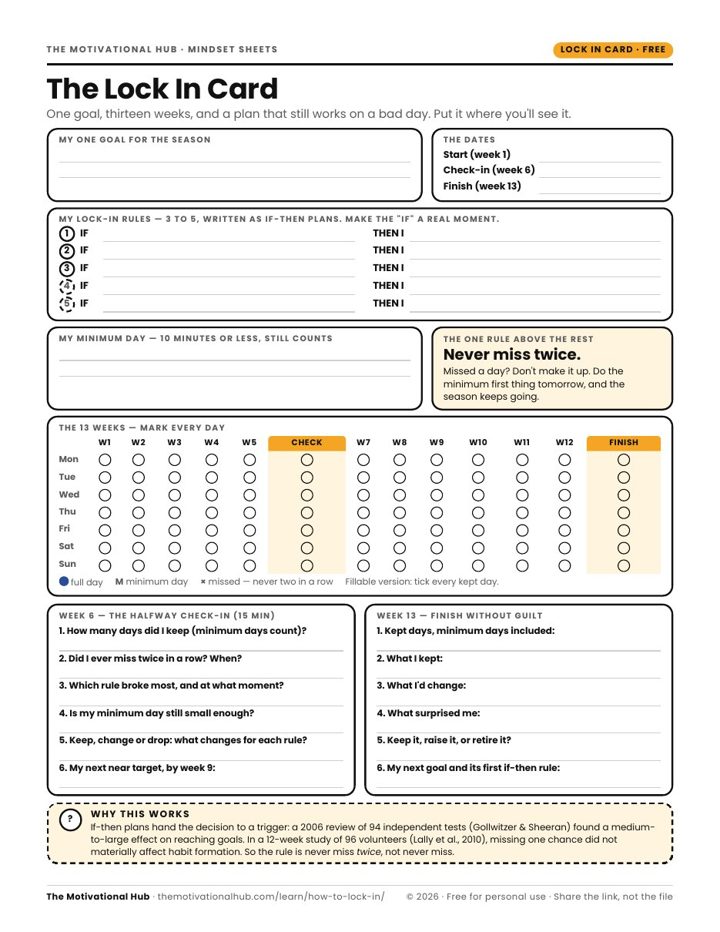
Free printable
Get the Lock In Card
Your whole 13-week plan on one page, so you don't have to remember any of this on a bad day.
Start with the free Lock In Card: the whole plan above on one printable page. The Goal Getter Pack has the paper tools for this plan: the If-Then Plan, the 90-Day Sprint, the Five-Minute Weekly Review and the Never-Miss-Twice Tracker. If your lock-in is about how you think, not just what you do, the 30-Day Mindset Reset gives you one sheet a day in an order that builds. For something smaller this week, try the free weekly mindset challenge and log it on the free Weekly Proof Sheet.
There are no official Winter Arc rules. People set their own, often a daily workout, an earlier wake-up, less social media or more rest. The rules that last are written as if-then plans and come with a minimum day.
No. The September 1 date is a hashtag, not a deadline. A 13-week season that starts the first week of October ends right around New Year's, which is a natural finish line.
One, maybe two. Every goal needs its own rules and its own minimum day, and that adds up fast. If you want more, run a second season in the new year.
Start again the next day with the minimum. No penalty and no make-up session. Then look at which rule broke. Two misses in a row often means a trigger that doesn't fit your real week, not a lack of willpower.
Self-help methods, not treatment. They work best alongside real support, not instead of it. If you're in a hard place, call or text 988 (US).