Mindset Sheets · Pack
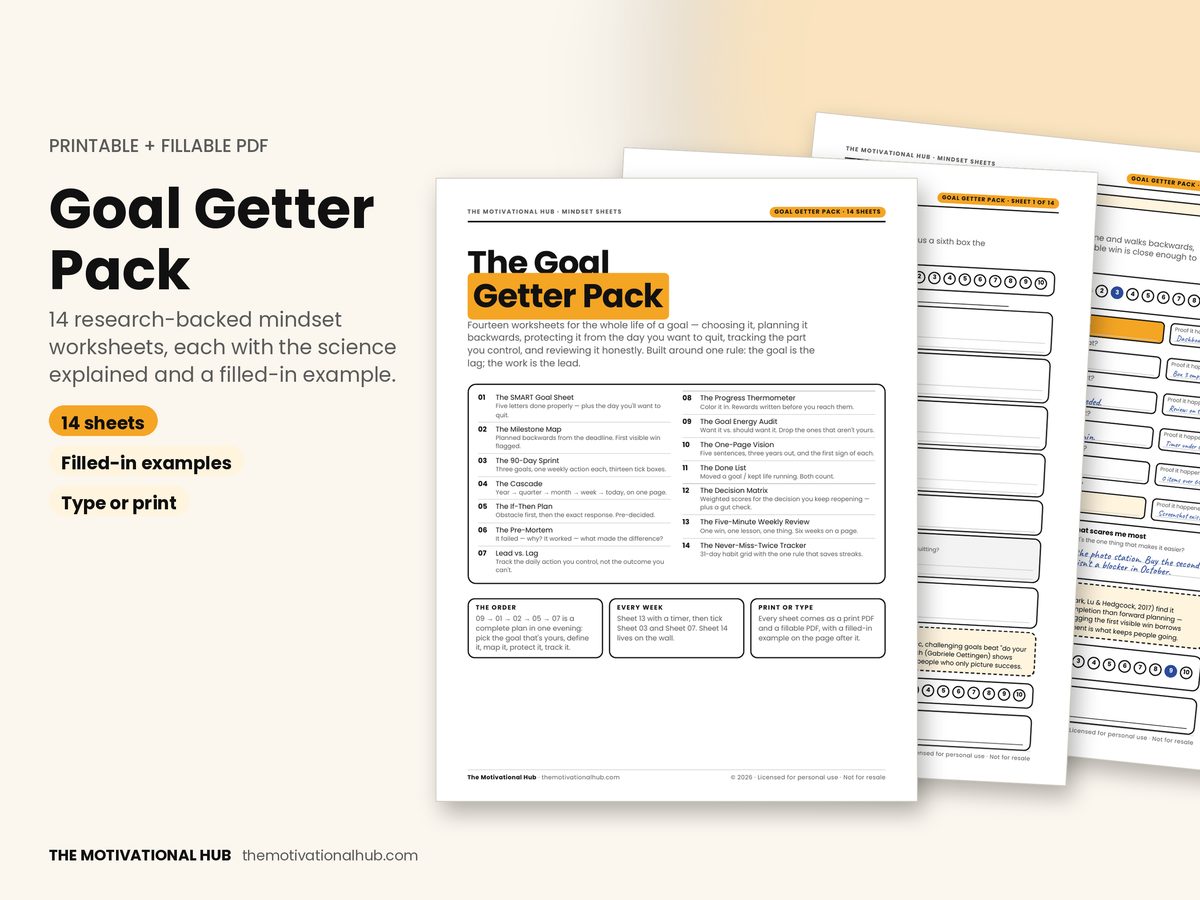
Fourteen sheets that take a goal from a wish to a plan you'll actually follow: the one-page vision, a goal sharpened until it's real, the if-then plan, a pre-mortem, lead-versus-lag measures, and a weekly review that takes five minutes.
What's inside
Five letters everyone knows and almost nobody uses properly — plus a sixth box the standard version leaves out: the day you'll want to quit.
Most plans start at today and hope. This one starts at the deadline and walks backwards, so every milestone has a date it must land on — and the first visible win is close enough to touch.
A year is too long to feel and a week is too short to matter. Ninety days is the sweet spot: three goals, maximum, one weekly action each, and a review that sets the next sprint from real data.
Year, quarter, month, week, today — on one page, so today's to-do list can't drift away from the year's point. Every line should be able to answer: "and that serves what?"
Goals fail the day the plan meets its first obstacle and you have to decide, tired, what to do. Make those decisions now — obstacle first, then the exact response.
It's the deadline. Left side: the goal died — write its cause of death. Right side: it worked — write what made the difference. You'll notice the two lists are the same list, seen from opposite ends.
A goal is a lag measure — you find out if you hit it after it's too late to change anything. The number you can move today is the lead measure. Track that one daily, and the lag takes care of itself.
Some goals are just a number that needs to go up. Color a segment every time it does, and write the reward before you reach it — so the milestone has something waiting.
Some of the goals on your list are yours. Some got there because someone said you should want them. Rate each one twice — how much you want it, and how much you think you should — and watch the gap tell on itself.
No magazine cutouts — just words. One sentence per area of life, three years out, in the present tense. Then the first small sign that it's starting to come true.
The to-do list only ever shows you what's left. This one shows you what happened. Two columns — things that moved a goal, and things that kept life running — because both count, and the second one is why the first one felt hard.
For the decisions that keep you up at night. Score each option against what actually matters to you — weighted, so the criterion you care about most counts most — then check whether the math agrees with your gut, and why.
Three questions, five minutes, every Sunday. Six weeks on one page so the pattern shows up — and so you can't pretend the good weeks didn't happen.
Streaks break. That's not the failure — the second miss is. Fill a dot for every day you did the habit, an × for every day you didn't, and never let two ×s sit next to each other.
Instant download. Licensed for personal use. Questions: hello@themotivationalhub.com
What every sheet has
The same 1–10 question at the top and the bottom. The gap between the two numbers is the sheet working.
Two sentences of the actual research, Dweck, Beck, Gollwitzer, Neff, in plain English on every page.
Every sheet is followed by a finished one. Real-looking, not perfect. Read it first when you're tired.
Each sheet ends with the one thing you'll do in the next 24 hours. Thinking changes nothing; that one action does.
Also in the Hub
A note on what these are. The Mindset Sheets are self-help worksheets built on well-studied methods (cognitive behavioral techniques, growth-mindset research, implementation intentions, self-compassion work) written in plain language for everyday use. They are not therapy or treatment. If low mood, anxiety, or hopelessness is constant or getting in the way of daily life, please talk to a doctor or a licensed counselor. In the US, call or text 988 in a crisis.