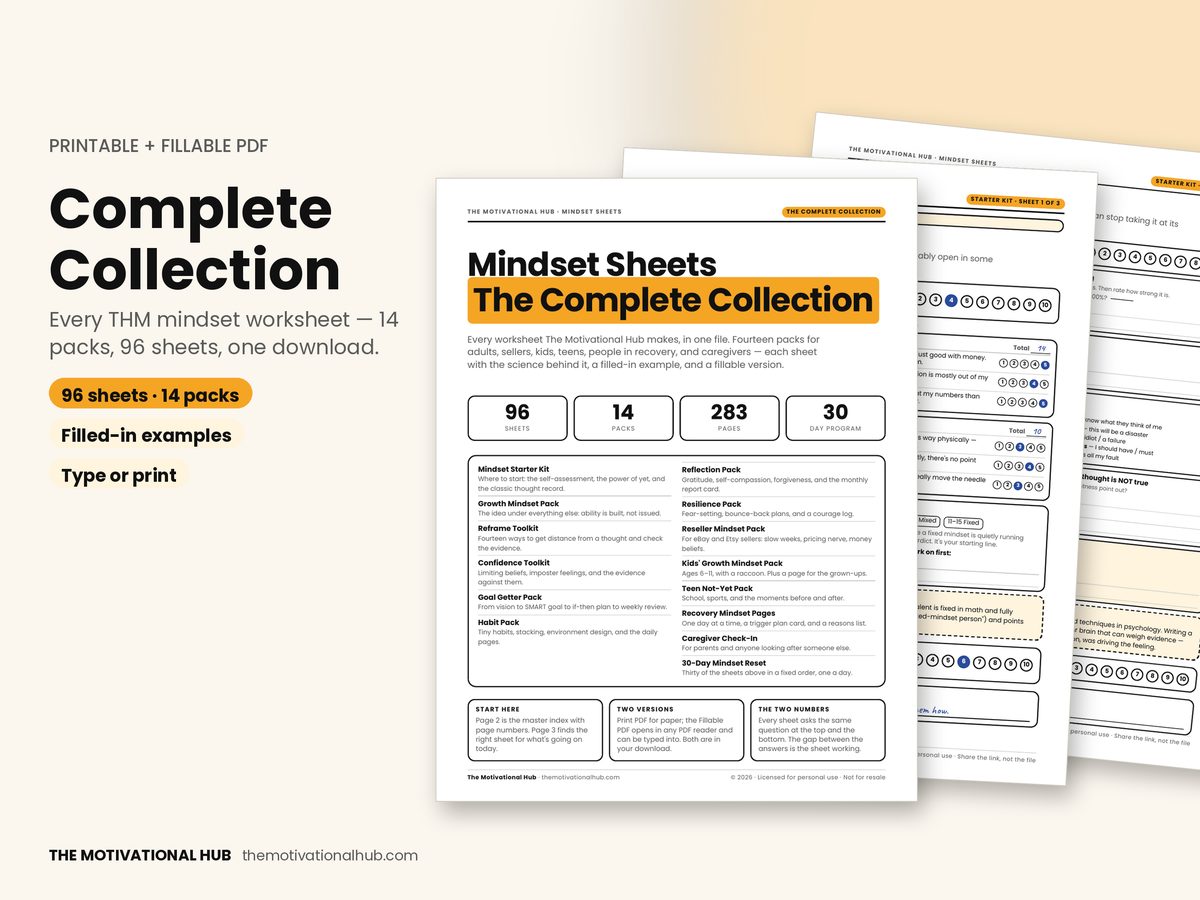
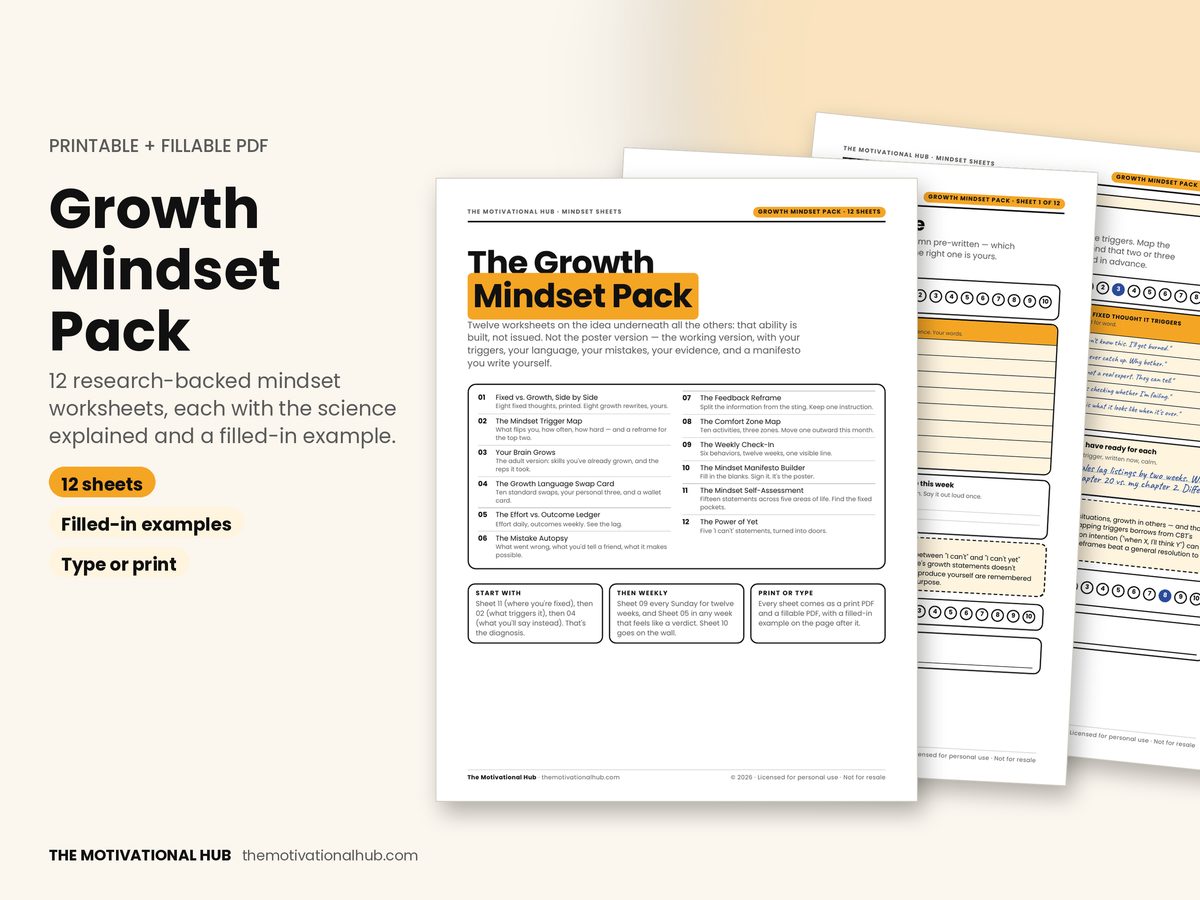
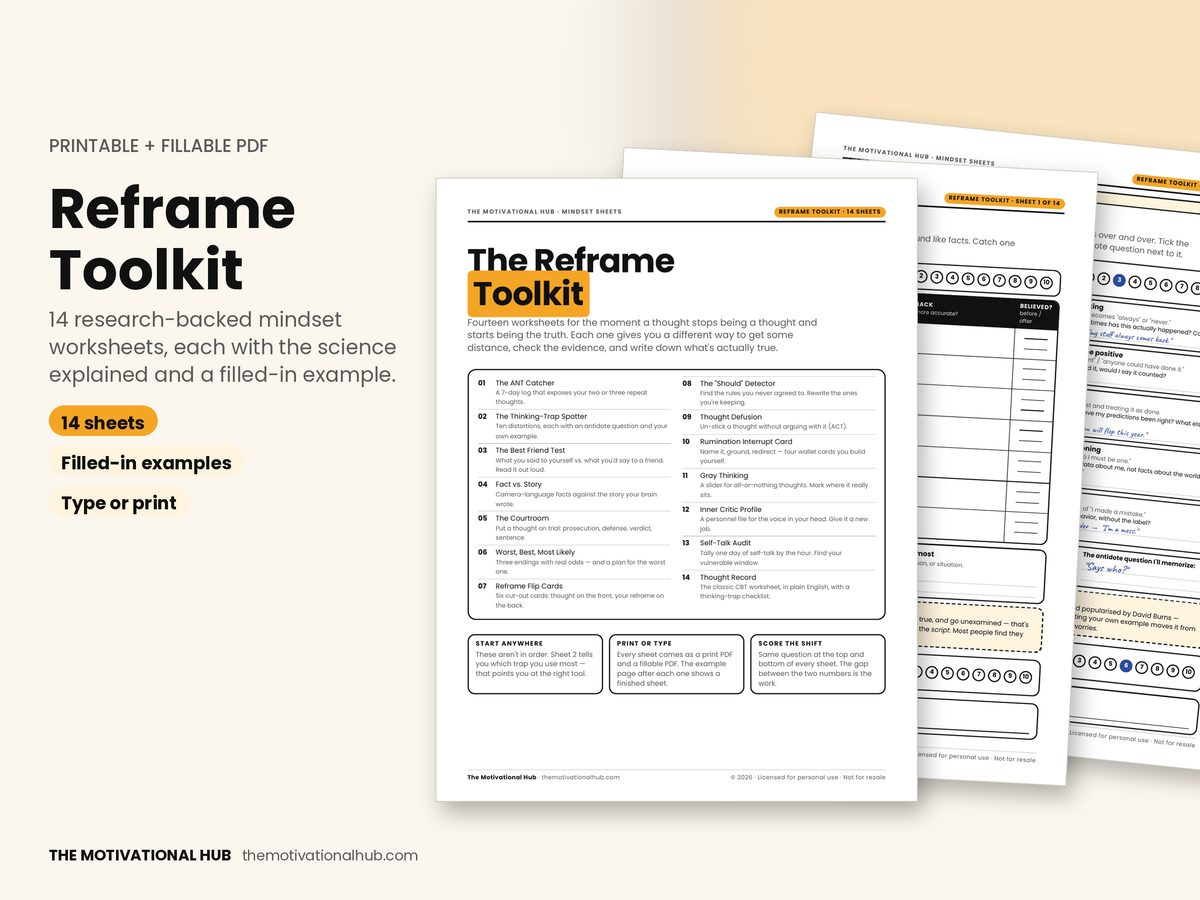
Mindset Sheets · Pack
One sheet a day for thirty days, in an order that builds: week one finds where you actually are, week two reframes the thoughts, week three works on beliefs, confidence and direction, week four on habits and resilience, and the last two days review and commit.
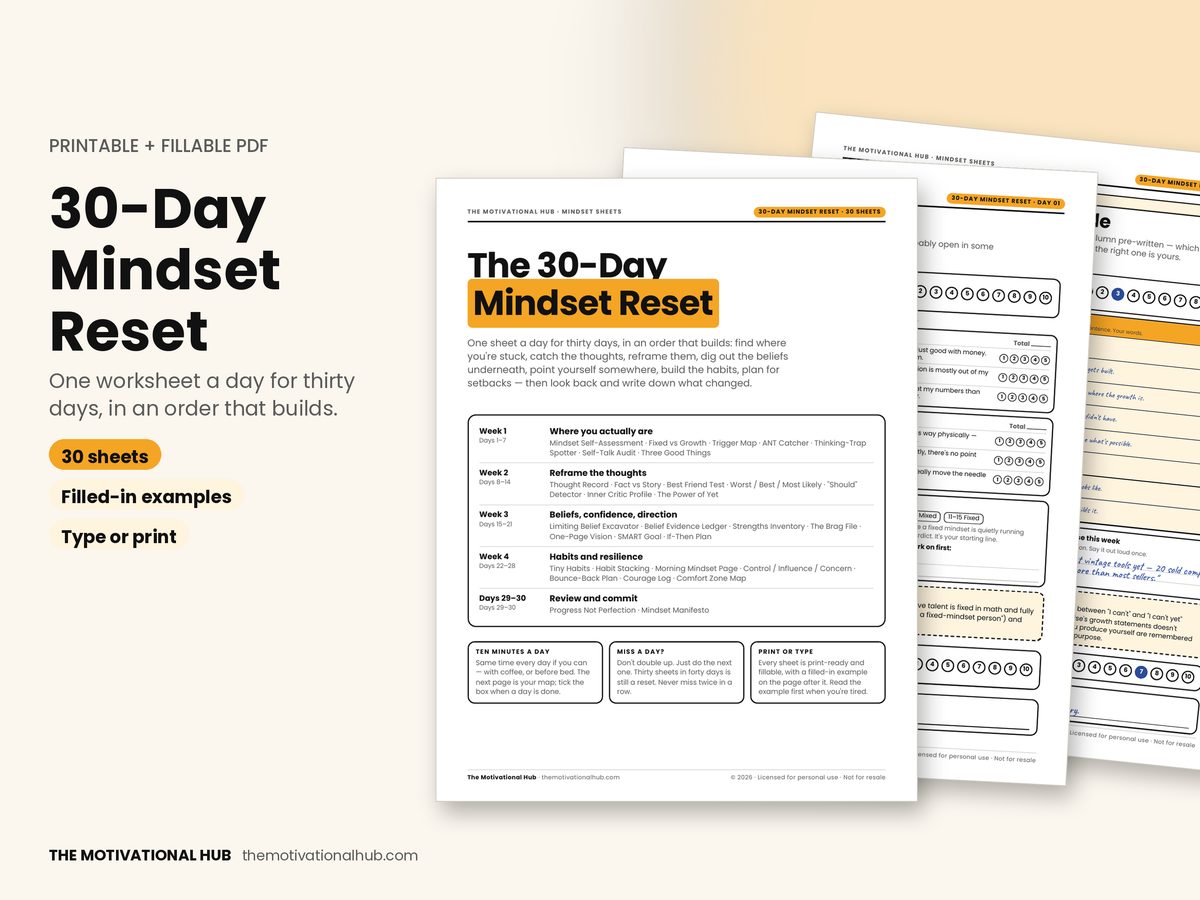
The thirty days
Most people aren't "fixed" or "growth" across the board. You're probably open in some areas and quietly stuck in others. This sheet shows you where.
Every chart of fixed and growth mindset gives you the growth column pre-written — which is why nobody remembers it. Here the left column is filled in and the right one is yours. Rewrite each fixed thought in words you'd actually say.
A fixed mindset isn't a personality — it's a reflex, and reflexes have triggers. Map the situations that flip you, rate how often and how hard, and you'll find that two or three situations do most of the damage. Those get a reframe prepared in advance.
ANTs are Automatic Negative Thoughts — uninvited, and they sound like facts. Catch one a day for a week and the pattern shows itself.
Negative thoughts aren't random — they use the same ten tricks over and over. Tick the ones you recognize, write your own example, and keep the antidote question next to it.
One day, one tally. Each time you catch negative self-talk, mark the hour and jot one word for what it was about. By bedtime you'll know your vulnerable window.
The classic gratitude exercise, with the missing column: for one of the three, write your part in making it happen. Gratitude alone builds contentment. Gratitude plus agency builds the sense that you can make more of it.
You can't stop a negative thought from showing up — but you can stop taking it at its word. Put one on trial.
Something happens. Then your brain writes a story about what it means — fast, confident, and usually unkind. Separate the two, and most of the sting disappears with the story.
You would never talk to a friend the way you talk to yourself. So don't. Write down what you said to yourself — then write what you'd say to your best friend in the exact same spot.
Catastrophizing only ever shows you one ending. Write all three — then make a plan for the worst one, so it stops being a monster and becomes a Tuesday.
Every "should" is a rule somebody handed you — and most never got checked. Find them, find out who wrote them, and rewrite the keepers in your own words.
The voice that tears you down isn't you — it's a character with a job. Fill out its personnel file, then give it a better job.
"I can't do this" is a full stop. "I can't do this yet" is a doorway. Write down the things you've been telling yourself you can't do — then walk through the door.
A limiting belief feels like a fact about you. Dig down a few layers and it usually turns out to be a sentence somebody said once — somebody who didn't have the authority to decide who you are.
You can't argue an old belief out of your head. You can bury it under evidence. One entry a day, for 30 days — anything that happened that the old belief can't explain.
Most people can list their weaknesses in seconds and their strengths never — because nobody asked for proof of the weaknesses. Pick your top five, attach a story to each, and give each one a job this week.
Not a list of dates and job titles — a list of skills, each with a story that proves it. Sorted this way it does double duty: a confidence file for bad days, and prep for any interview, pitch, or pricing conversation.
No magazine cutouts — just words. One sentence per area of life, three years out, in the present tense. Then the first small sign that it's starting to come true.
Five letters everyone knows and almost nobody uses properly — plus a sixth box the standard version leaves out: the day you'll want to quit.
Goals fail the day the plan meets its first obstacle and you have to decide, tired, what to do. Make those decisions now — obstacle first, then the exact response.
Habits die on bad days, not good ones. So give every habit three sizes — a bare minimum you could do with the flu, a normal day, and a great day — and make the rule that the smallest version still counts.
New habits don't need willpower. They need an anchor — something you already do, every day, without deciding. Map your real routine first, then bolt each new habit onto an anchor with one sentence.
Three lines, before the phone. An intention for the day, one thing to look forward to, and the one thing you'll do even if you don't feel like it. A week on a page, so you can see Thursday from Monday.
Three rings. The outer one is everything you're worried about. The middle is what you can nudge. The inner one is what you actually control — and it's the only ring where effort turns into anything. Sort the week's worries, then act from the middle of the page.
Every goal gets derailed. The difference between people who recover and people who quit isn't willpower — it's whether the recovery was planned before the derailment. Write this for one specific goal, on a good day, and file it for the bad one.
Every time you do something that scares you, log two numbers: how afraid you were before, and how it actually went. After eight entries you'll have a personal data set on one question — how often is the fear right? — and the answer is almost always "rarely."
Growth happens in the stretch zone — hard enough to be uncomfortable, not so hard you freeze. The trick is knowing which of your activities live where. Place ten, then pick one to move outward this month.
Perfectionism measures you against an imaginary finished version. This sheet measures you against you — a year ago, today, a year from now — in four areas. Progress is only invisible when nobody writes it down.
Every growth-mindset poster was written by someone else. This one gets written by you, in the blanks, and signed — and then it is the poster. Fill it in slowly. Every blank is a decision.
Instant download. Licensed for personal use. Questions: hello@themotivationalhub.com
What every sheet has
The same 1–10 question at the top and the bottom. The gap between the two numbers is the sheet working.
Two sentences of the actual research, Dweck, Beck, Gollwitzer, Neff, in plain English on every page.
Every sheet is followed by a finished one. Real-looking, not perfect. Read it first when you're tired.
Each sheet ends with the one thing you'll do in the next 24 hours. Thinking changes nothing; that one action does.
Also in the Hub
A note on what these are. The Mindset Sheets are self-help worksheets built on well-studied methods (cognitive behavioral techniques, growth-mindset research, implementation intentions, self-compassion work) written in plain language for everyday use. They are not therapy or treatment. If low mood, anxiety, or hopelessness is constant or getting in the way of daily life, please talk to a doctor or a licensed counselor. In the US, call or text 988 in a crisis.