Mindset Sheets · Pack
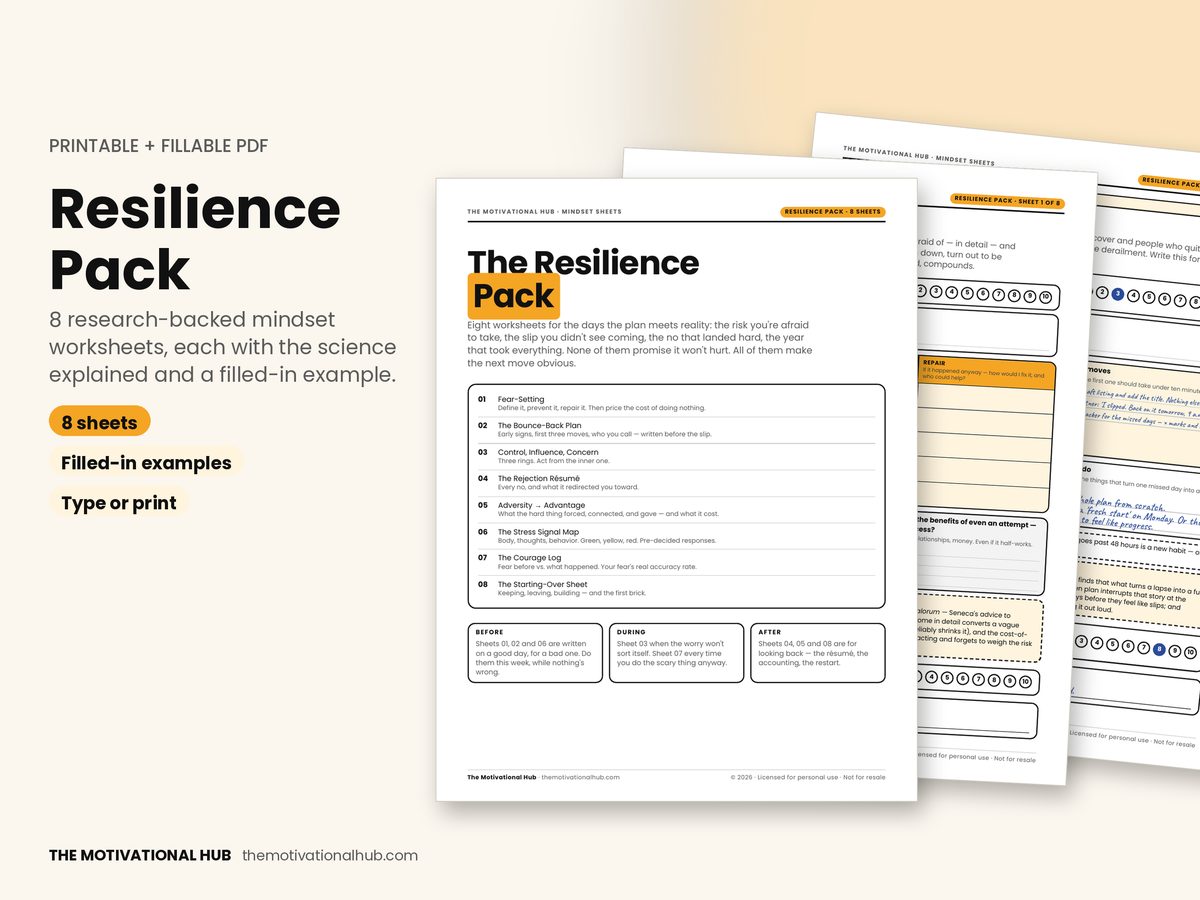
Eight sheets for the hard week: fear-setting, a bounce-back plan written before you need it, sorting what you control from what you don't, a rejection résumé, and a courage log.
What's inside
Goal-setting asks what you want. Fear-setting asks what you're afraid of — in detail — and then what it would take to prevent it, or repair it. Most fears, written down, turn out to be recoverable in a weekend. The cost of not trying, on the other hand, compounds.
Every goal gets derailed. The difference between people who recover and people who quit isn't willpower — it's whether the recovery was planned before the derailment. Write this for one specific goal, on a good day, and file it for the bad one.
Three rings. The outer one is everything you're worried about. The middle is what you can nudge. The inner one is what you actually control — and it's the only ring where effort turns into anything. Sort the week's worries, then act from the middle of the page.
A résumé lists what you achieved. This one lists what turned you down — and what each "no" redirected you toward. Read it once and the pattern is obvious: the rejections are load-bearing.
Not "everything happens for a reason." Some things just cost you. But most hard things also gave you something you couldn't have got any other way — and you don't get the benefit until you name it. Pick one hard thing and do the accounting, both columns.
Stress doesn't arrive all at once — it climbs, and it sends signals on the way up. Most people only notice the red ones. Map your own body, thought, and behavior signals, then decide what green, yellow, and red each mean, and what you'll do at each.
Every time you do something that scares you, log two numbers: how afraid you were before, and how it actually went. After eight entries you'll have a personal data set on one question — how often is the fear right? — and the answer is almost always "rarely."
For the restart after the job loss, the business that didn't work, the year that took everything. Starting over is not starting from zero — you're bringing things with you. This sheet sorts what comes, what stays behind, and what gets built new.
Instant download. Licensed for personal use. Questions: hello@themotivationalhub.com
What every sheet has
The same 1–10 question at the top and the bottom. The gap between the two numbers is the sheet working.
Two sentences of the actual research, Dweck, Beck, Gollwitzer, Neff, in plain English on every page.
Every sheet is followed by a finished one. Real-looking, not perfect. Read it first when you're tired.
Each sheet ends with the one thing you'll do in the next 24 hours. Thinking changes nothing; that one action does.
Also in the Hub
A note on what these are. The Mindset Sheets are self-help worksheets built on well-studied methods (cognitive behavioral techniques, growth-mindset research, implementation intentions, self-compassion work) written in plain language for everyday use. They are not therapy or treatment. If low mood, anxiety, or hopelessness is constant or getting in the way of daily life, please talk to a doctor or a licensed counselor. In the US, call or text 988 in a crisis.