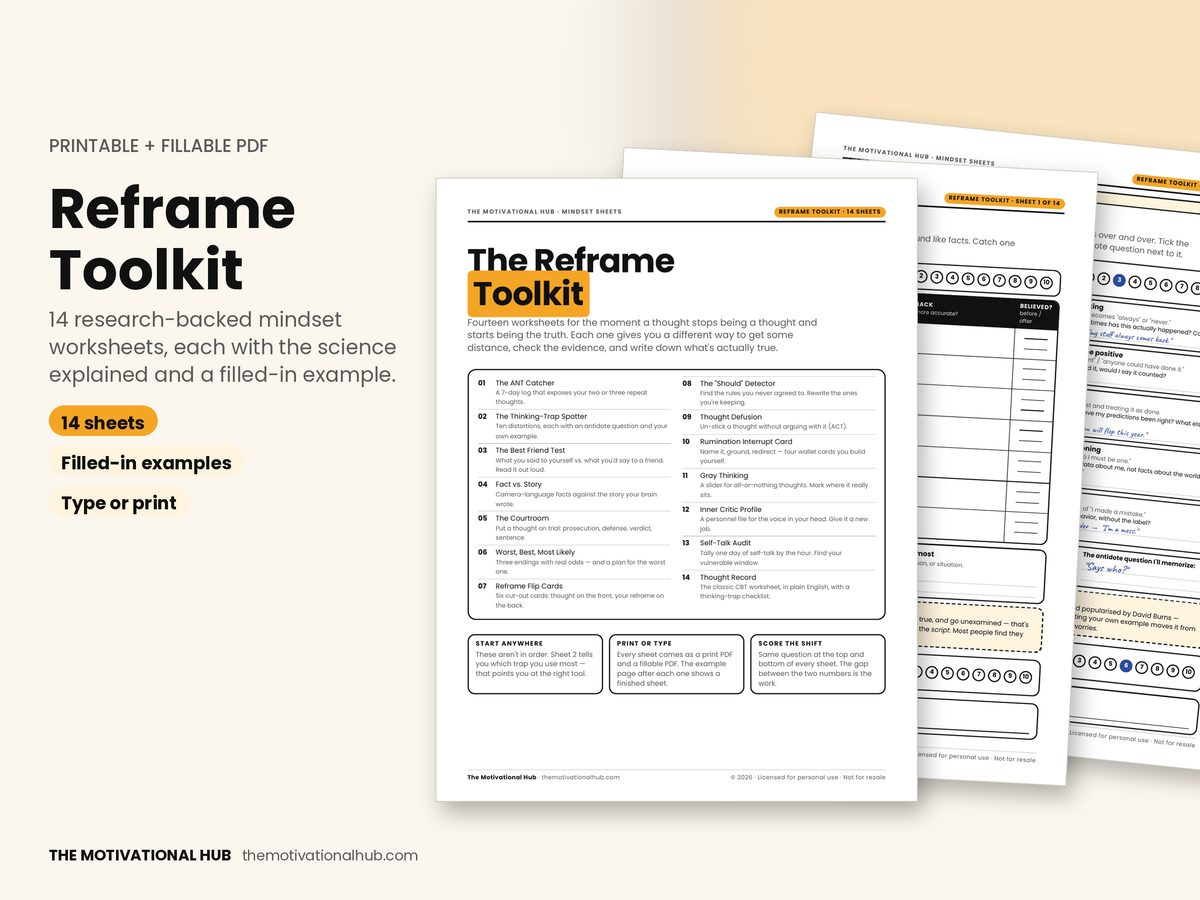
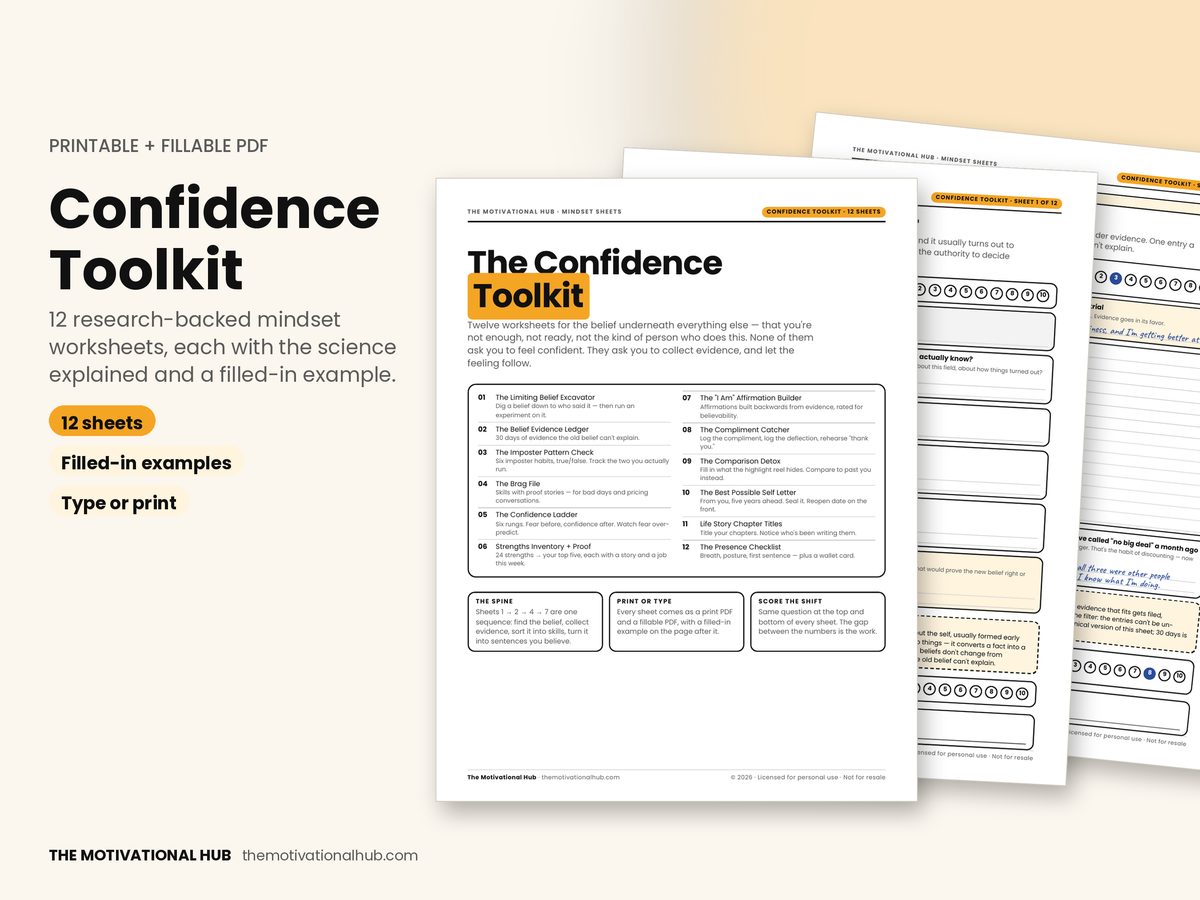
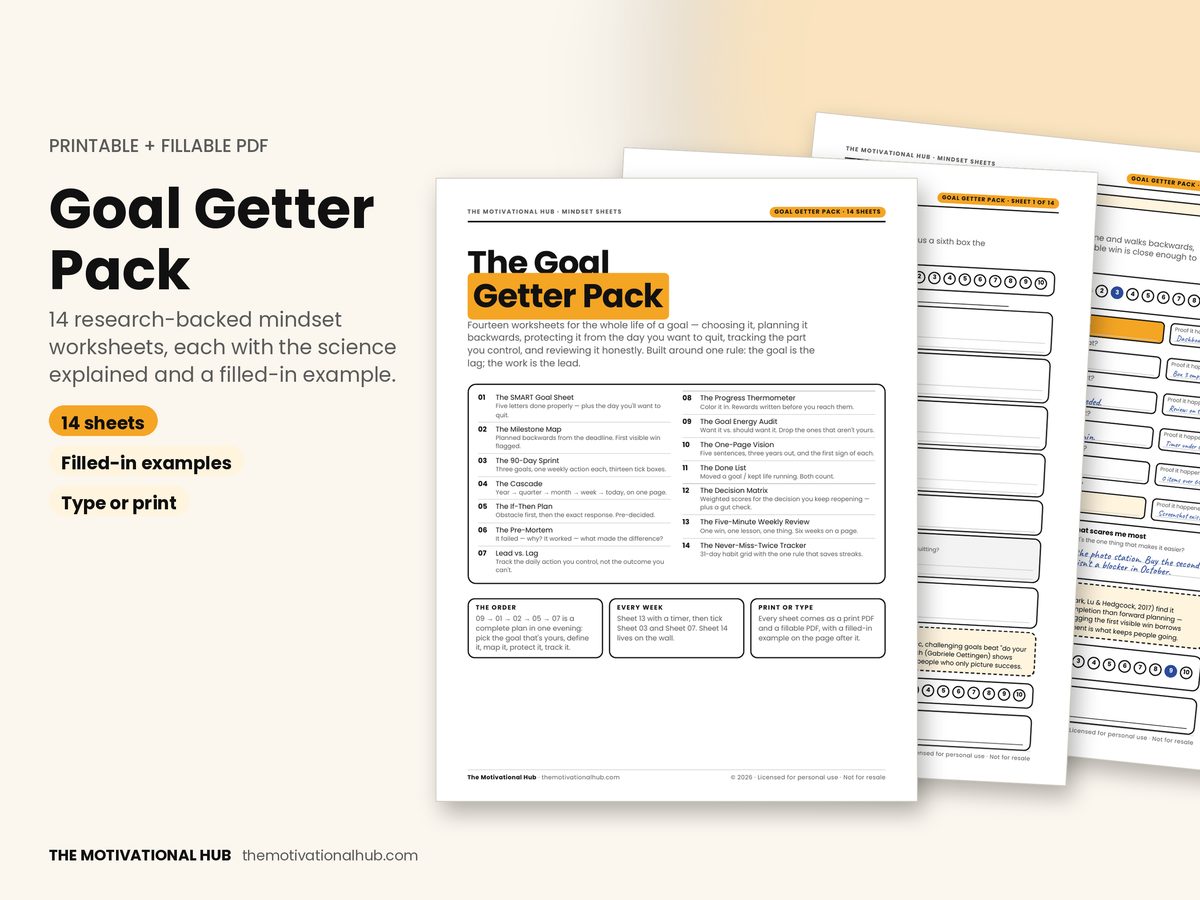
Mindset Sheets · Pack
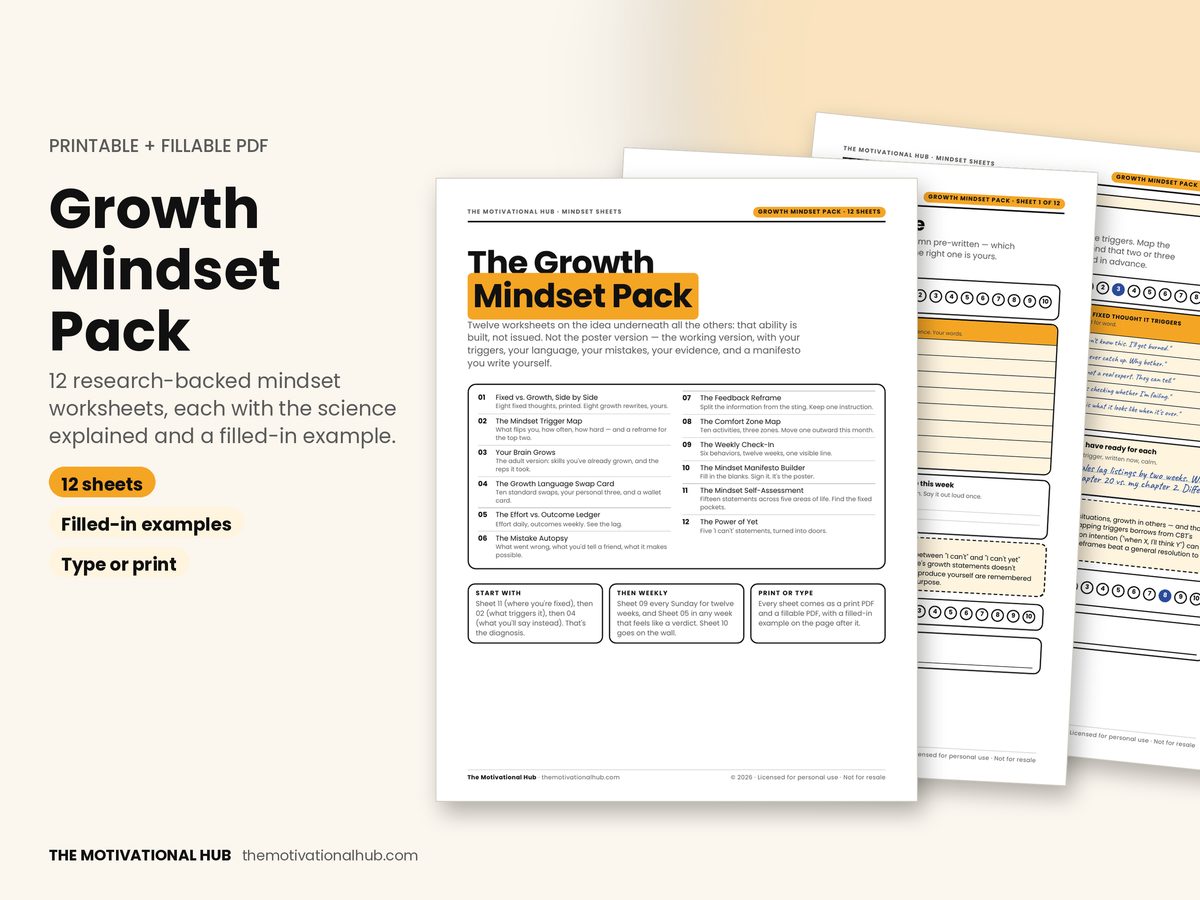
Twelve sheets on the idea under everything else on this site: ability is built, not issued. Map what flips you into "I can't", swap the language, run a mistake autopsy without the blame column, and finish by writing the manifesto yourself.
What's inside
Every chart of fixed and growth mindset gives you the growth column pre-written — which is why nobody remembers it. Here the left column is filled in and the right one is yours. Rewrite each fixed thought in words you'd actually say.
A fixed mindset isn't a personality — it's a reflex, and reflexes have triggers. Map the situations that flip you, rate how often and how hard, and you'll find that two or three situations do most of the damage. Those get a reframe prepared in advance.
The kids' version is a poster of a brain lifting weights. The adult version is evidence: things you couldn't do, that you now can, and what happened in between. Your brain has done this before. Here's the record.
Ten standard swaps, printed. Then the three that matter: the sentences you say, and what you'll say instead — on a card the size of your hand.
Effort is scored every day. Outcomes are scored once a week. Keeping them on separate clocks teaches the thing a fixed mindset never learns: results lag effort, sometimes by weeks — and the only column you can push on is the first one.
A fixed mindset treats a mistake as a verdict and moves on fast. A growth mindset slows down and opens it up. This is the slow version: what happened, what it taught, what you'd tell a friend — and the question most autopsies skip: what does this mistake make possible?
Feedback arrives as one lump: the information and the sting, together. A fixed mindset swallows the sting and spits out the information. This sheet separates them — so you can keep the useful part and let the rest go.
Growth happens in the stretch zone — hard enough to be uncomfortable, not so hard you freeze. The trick is knowing which of your activities live where. Place ten, then pick one to move outward this month.
Six questions, same every week, scored 1–5. Twelve weeks on one page, so the answer to "is this actually changing?" is a line you can see — not a feeling you have to trust.
Every growth-mindset poster was written by someone else. This one gets written by you, in the blanks, and signed — and then it is the poster. Fill it in slowly. Every blank is a decision.
Most people aren't "fixed" or "growth" across the board. You're probably open in some areas and quietly stuck in others. This sheet shows you where.
"I can't do this" is a full stop. "I can't do this yet" is a doorway. Write down the things you've been telling yourself you can't do — then walk through the door.
Instant download. Licensed for personal use. Questions: hello@themotivationalhub.com
What every sheet has
The same 1–10 question at the top and the bottom. The gap between the two numbers is the sheet working.
Two sentences of the actual research, Dweck, Beck, Gollwitzer, Neff, in plain English on every page.
Every sheet is followed by a finished one. Real-looking, not perfect. Read it first when you're tired.
Each sheet ends with the one thing you'll do in the next 24 hours. Thinking changes nothing; that one action does.
Also in the Hub
A note on what these are. The Mindset Sheets are self-help worksheets built on well-studied methods (cognitive behavioral techniques, growth-mindset research, implementation intentions, self-compassion work) written in plain language for everyday use. They are not therapy or treatment. If low mood, anxiety, or hopelessness is constant or getting in the way of daily life, please talk to a doctor or a licensed counselor. In the US, call or text 988 in a crisis.