Mindset Sheets · Pack
Eight sheets for the part of change that has nothing to do with motivation: tiny habits, stacking them onto what you already do, designing the room so the right thing is the easy thing, and bookending the day.
What's inside
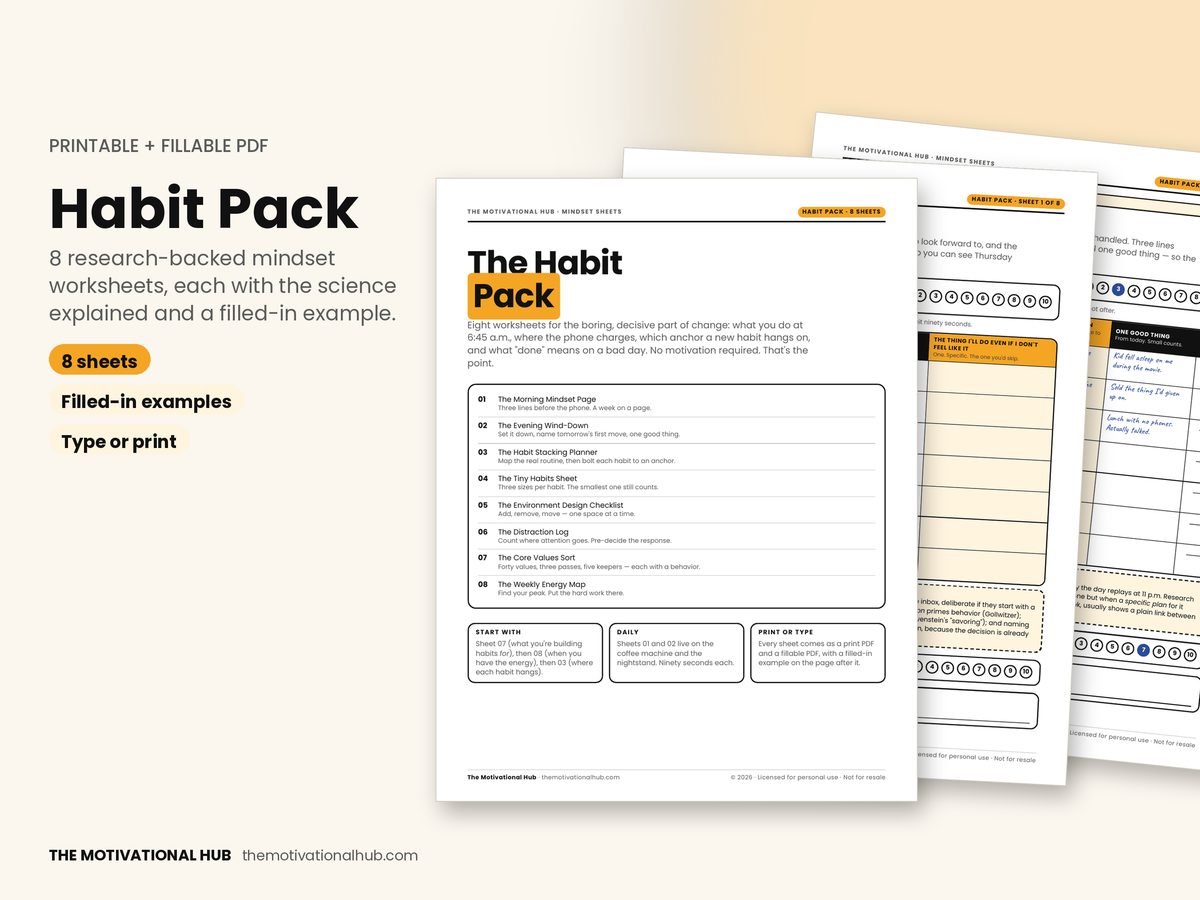
Three lines, before the phone. An intention for the day, one thing to look forward to, and the one thing you'll do even if you don't feel like it. A week on a page, so you can see Thursday from Monday.
The brain keeps looping on open tasks unless it believes they're handled. Three lines before bed: what you're setting down, tomorrow's first move, and one good thing — so the loop has somewhere to land.
New habits don't need willpower. They need an anchor — something you already do, every day, without deciding. Map your real routine first, then bolt each new habit onto an anchor with one sentence.
Habits die on bad days, not good ones. So give every habit three sizes — a bare minimum you could do with the flu, a normal day, and a great day — and make the rule that the smallest version still counts.
You don't rise to your intentions; you fall to your surroundings. Walk each space you actually use and change three things: something to add, something to remove, something to move. Make the good habit the path of least resistance.
You can't fix a distraction you haven't counted. For one day, make a tally mark every time your attention leaves the task — sorted by where it went — and write the response for each type before it happens again.
Habits stick when they serve something you care about — and fall apart when they serve someone else's idea of a good life. Sort forty values, keep five, and give each one a behavior this week.
You don't have the same brain at 9 a.m. and 3 p.m. — so stop scheduling as if you do. Rate your energy every waking hour for a week, then put the hard work where the peaks are and the admin where the slumps are.
Instant download. Licensed for personal use. Questions: hello@themotivationalhub.com
What every sheet has
The same 1–10 question at the top and the bottom. The gap between the two numbers is the sheet working.
Two sentences of the actual research, Dweck, Beck, Gollwitzer, Neff, in plain English on every page.
Every sheet is followed by a finished one. Real-looking, not perfect. Read it first when you're tired.
Each sheet ends with the one thing you'll do in the next 24 hours. Thinking changes nothing; that one action does.
Also in the Hub
A note on what these are. The Mindset Sheets are self-help worksheets built on well-studied methods (cognitive behavioral techniques, growth-mindset research, implementation intentions, self-compassion work) written in plain language for everyday use. They are not therapy or treatment. If low mood, anxiety, or hopelessness is constant or getting in the way of daily life, please talk to a doctor or a licensed counselor. In the US, call or text 988 in a crisis.