Weekly challenge · #1 · Week of September 14, 2026 · This week
This week's challenge is one thought record a day for five days, each aimed at a different kind of thought: a small one, a "should," a prediction, a mind-read, and the big one. Ten minutes a day with the free Thought Record sheet or the browser version. The point isn't five perfect reframes; it's finding out which thinking habit runs your week, and seeing your own before-and-after numbers prove it can move.
Pick a minor irritation from today (a message that landed wrong, a task you avoided) and run the full seven columns on it. The point is to learn the form on something that doesn't hurt.
Catch one sentence with "should" in it ("I should have finished that," "they should have called"). Run it. In the evidence-against column, ask who made the rule.
Find a thought about something that hasn't happened yet ("this will go badly," "they'll say no"). Run it, and notice that no amount of evidence can settle a prediction, so the balanced thought is usually "I don't know yet, and here's what I can do in the meantime."
Find a thought about what someone else thinks of you. Run it. The evidence-for column is almost always empty of facts, which is the lesson.
The thought that's been under the whole week. You've had four practice rounds; give this one fifteen minutes and every column. Then compare Friday's belief drop to Monday's.
A thought record works by making a thought sit still long enough to be questioned. Doing one is informative. Doing five in a row, each on a different type of thought, is diagnostic: by Friday the same distortion has usually shown up three times, and that's the one worth working on for the rest of the month. The daily belief numbers also give you something no single record can, a trend. Belief that drops from 85 to 60 on Monday and from 70 to 30 on Friday is the habit forming.
No. The Thought Reframer runs the same seven steps in your browser and gives you a card at the end. The printed sheet from the free Starter Kit is nicer for a five-day run because you can lay the five side by side on Friday.
Use whatever thought did. The types are there to make sure you meet the common distortions at least once; they're not a test.
That happens, and it's information. Usually the evidence-against column got rushed, or the thought is a prediction or a mind-read that evidence can't settle. Both are covered in the thought record explainer.
Self-help methods, not treatment. They work best alongside real support, not instead of it. If you're in a hard place, call or text 988 (US).
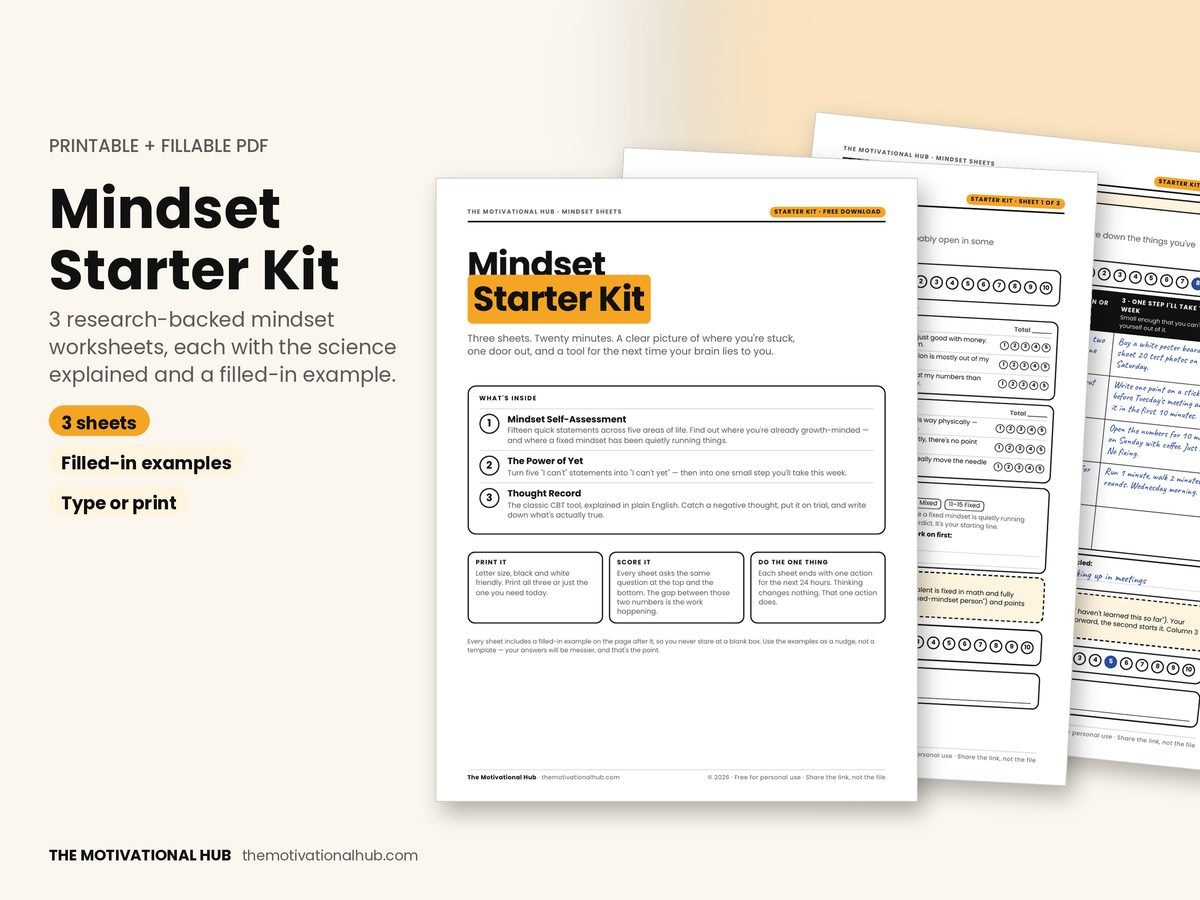
The sheet for this challenge
It's one of the three sheets in the Mindset Starter Kit, with a filled-in example page opposite the blank one. Print five for the week.